
Clearing Presqu'île
The licensing behind Sacha Vidal's album: forty-seven samples, a wound-up publisher, a daughter in Saint-Étienne and a bass line that had to be replayed.
Friday's album has eight tracks on it, and I can recite the paperwork for each. I started clearing "Presqu'île" on Monday 4 March last year and got the last signature on Friday 7 February this year. Mark Neilson asked me to explain why it took eleven months and whether it could be shorter in future. Here is the explanation. It probably could not.
What needs clearing
There are two things to clear whenever you lift a piece of an old recording. There is the master, which covers the sound as recorded, and there is the publishing, which covers the song. They are often held by different people, sometimes in different countries, and neither may know about the other. You need a yes from both.
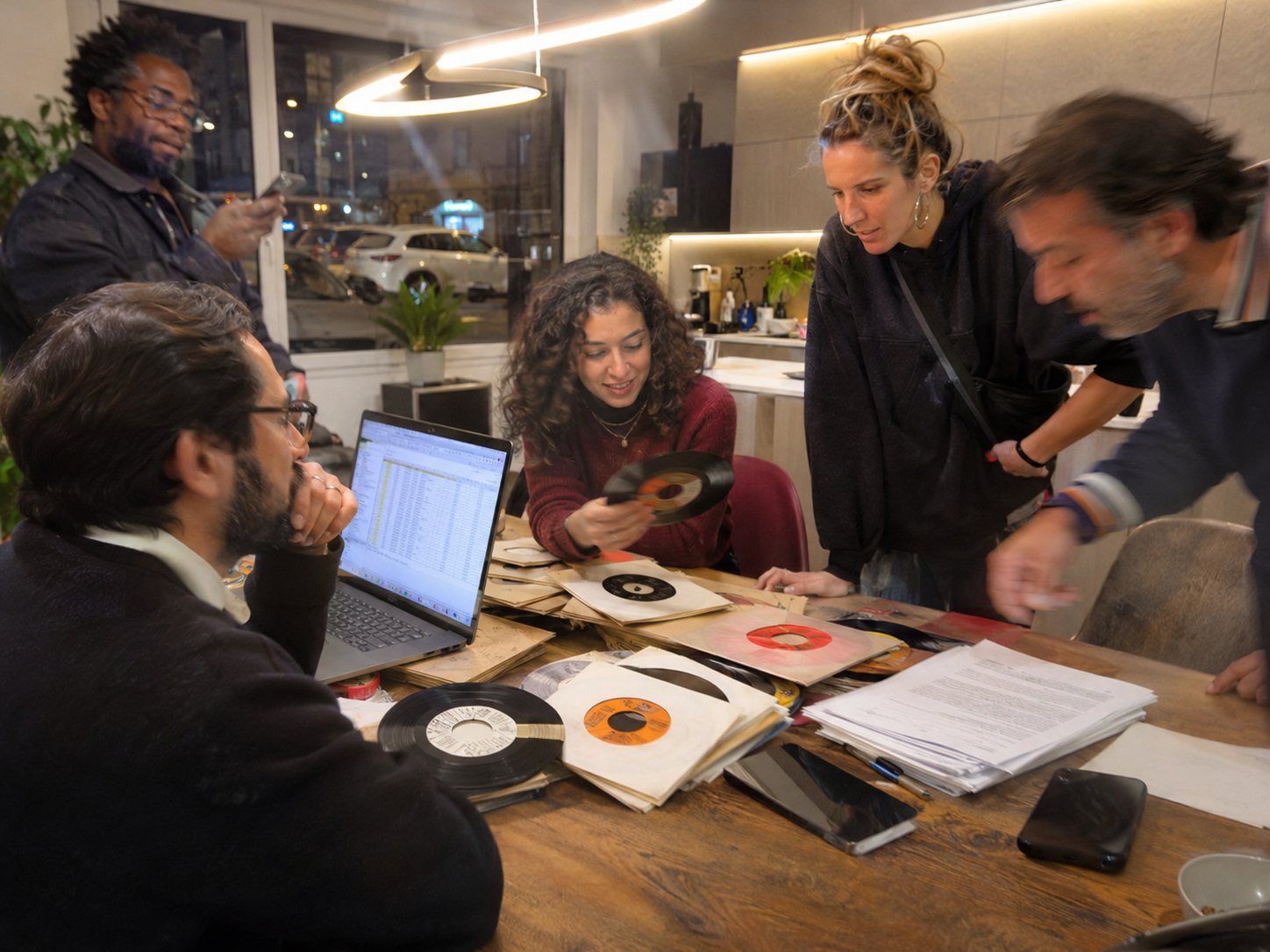
For a big catalogue this is an email to a department. Sacha Vidal does not sample big catalogues. Sacha has a very large collection of French soul 45s, a lot of them regional, many pressed in runs of a few hundred in the early seventies by labels that did not last. That is the whole point of the record, and it makes for difficult paperwork.
Sacha's first list, in felt tip, had forty-seven samples on it, after the most difficult had already been taken out.
The numbers
Of the forty-seven, thirty-one were cleared, nine were replaced with something else and seven were removed. Two tracks were rebuilt entirely. "Perrache" lost its original opening. For one cleared sample I stopped counting emails at thirty-eight. I wrote fourteen letters on paper, to people who do not use email, and once phoned someone's former colleague at a garage.
Terreaux
The best-known moment on the album is the horn line on "Terreaux", from a 7 inch of around 1973 by a soul group from the Lyon suburbs. The label folded in about 1976. Its publishing was held by a small company wound up in the eighties, and the rights passed to someone whose name I found in a commercial register, at an address that turned out to be a car park.
I spent six weeks on that. Then Sacha remembered a photo of the band on the sleeve, in which one of them is holding a bass with a name painted on the case. I found a man with that surname in an old union directory. He had died in 2009. His daughter lives in Saint-Étienne and teaches maths. She had never heard the record. Her father had told her he was once in a band, and she had assumed he was exaggerating.
I sent her the 7 inch transfer and the track, and it took her three weeks to reply. She could not sign for the master, but she had a box of his papers, and in it was a contract that showed who could.
"I told her it was a dance record. She asked me how long it was and I told her. She said her father would have complained that it was short." Priya Raman
Rhône
The bass line on "Rhône" came from a record whose rights sit with a company that knows exactly what it holds. They said no, in one line, with no reason given, as they are entitled to. Sacha spent about nine days unhappy about it, and then we looked at alternatives.
In the end Théo Marchand of Les Quais replayed a line on a borrowed bass in the lock-up in Bacalan, with Sacha on the phone from Lyon asking for it lazier. You cannot copy a line that closely without clearing the composition, so what you hear is a different line with a similar feel. I spent some time with a lawyer making sure of that.
Who gets what
Most of these deals were a flat fee plus a share. On a record that sells in the numbers this label sells, shares come to small amounts paid at long intervals, and I now keep thirty-one recurring royalty lines. Several will pay about four euros every six months. Mark has pointed out that the admin will cost more than the money, and that is correct. They will all be paid on time.
Sacha's next record is said to have hardly any samples in it. A parcel of 45s arrived in Lyon last week.